Mixed-Income and Inclusionary Housing Policies
Resources for communities to expand housing choices
People of any ability, age, financial status, race, and family size deserve to live in the community they choose (Imagine 2050). The Met Council encourages local governments to consider mixed-income or inclusionary housing policies as an impactful tool to incorporate into their housing strategies to advance this objective. Mixed-income housing policies:
- Create affordable homes in developments that otherwise would not include them
- Leverage the private market to create affordable homes with little or no public subsidy, often in amenity-rich areas with little affordable housing
- Support housing goals such as tempering gentrification, mitigating displacement, affirmatively furthering fair housing, and creating resilient communities.
Mixed-income housing policies are not one-size-fits-all. Each community must decide which type of mixed-income policy is appropriate, when affordable units should be required, and whether the city will contribute resources to mixed-income income projects.
Regional housing nexus study
In 2026, the Met Council, working with Community Scale, completed a regional housing nexus study. Increased national attention to inclusionary housing ordinances and the need for local data to inform policy development prompted the Met Council to proactively commission this study.
The regional housing nexus study is designed to assist local governments in developing mixed-income or inclusionary housing policies. The study includes a nexus and inclusionary housing calculator for local governments to explore what demand market-rate development can create and the potential impacts an inclusionary housing fee could have on the affordability of homes in their community.
What is a nexus study?
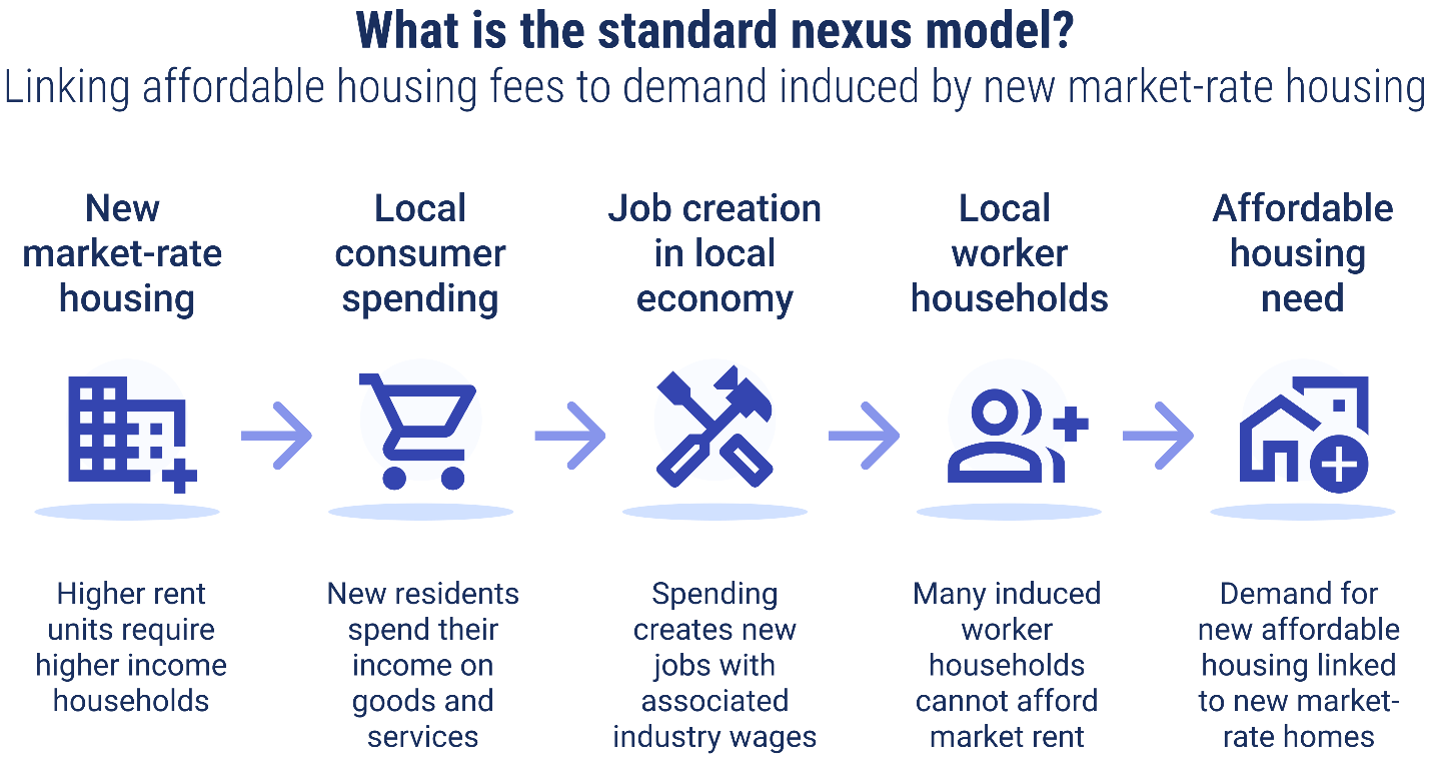
Inclusionary housing policies place a cost on private development. They must be supported by a demonstrated causal relationship or “nexus” between the construction of new market-rate housing and the affordable housing demand it generates.
A nexus study establishes that the cost proposed to the private developer is intended to mitigate the impact of a given development on the community. A nexus study quantifies this relationship by tracing how residents in new market-rate homes spend money on local goods and services, how that spending supports jobs across a range of industries, and how many of those workers earn wages too low to afford market-rate housing in the same community.
The result is a per-unit estimate of affordable housing demand created by new development. This analysis establishes the maximum justifiable fee or affordable housing requirement that can be tied to new development.
Why the Met Council?
The legislature empowers the Met Council to allocate to cities and townships a share of the region’s need for affordable housing. The Met Council forecasts future affordable housing need using a regional economic model, then allocates a share of the overall need to all municipalities forecast to experience sewer-serviced household growth over the next decade.
For the 2031-2040 planning decade, the Met Council projects a regional need of 39,700 new affordable housing units, including 21,150 homes that are affordable to households living on 30% of the area median income or less, or less than $40,000 annually for a family of four. To meet this need, the region will need to build approximately 3,900 affordable homes per year on average through 2040. Subsidy and grant programs alone cannot meet this need; local tools, including inclusionary housing policies, are critical to ensuring households have housing options to choose from.
A nexus study helps cities communicate how market-rate development and household growth correlate to local affordable housing need. The Met Council calculator determines both the nexus between a market-rate development and the induced demand for affordable housing, and the nexus between market-rate development and the forecasted total need for affordable housing in that city or township for the decade.
Read more about the regional housing nexus study and how the calculator was built.
The nexus and inclusionary housing calculator
The nexus and inclusionary housing calculator identifies a maximum feasible fee that aligns with the affordable housing need created by new development. Many communities choose to set fees below this maximum to avoid discouraging development. This tool also provides a platform for financial feasibility analysis to help cities evaluate what level of fees or requirements the local market can realistically support.
The Met Council nexus and inclusionary housing calculator uses standard housing nexus methodology to establish a rational nexus between market-rate residential construction and the affordable housing demand it generates, providing an analytical foundation for local inclusionary housing fees.
The calculator evaluates affordable housing requirements in two ways:
- Within the established nexus: Require no more affordable housing than the maximum justifiable rate determined in the nexus analysis, and
- Within economic feasibility: Require no more affordable housing than can be supported by the market, as determined by the economic feasibility assessment.
Who should use the calculator?
Local governments interested in:
- Understanding the affordable housing demand generated by market-rate development
- Establishing or updating inclusionary housing requirements
- Setting or revising an inlieu fee structure.
Download the Nexus Calculator (xlsx)
To learn more about how to use the calculator and how it was built, refer to our
Regional Housing Nexus Study webinar.